First impressions are important. When it comes to first impressions, the case your festival submission DVD comes in may be the best shot you have at starting off on the right foot with the person who sees your movie first. The person who watches your movie may not be the person who takes it out of the envelope, and film festivals often separate the press kits and other material that come with a submission from the DVD or tape when they put it in the pile of films to be watched. That leaves the case itself to communicate something about your movie to a prospective viewer before they pop it into the player.
I've seen submissions come in all kinds of packaging: simple paper sleeves, CD jewel cases, regular black DVD cases, colored plastic "seashell" cases, and even elaborate metal boxes. For my money, the best of all of these are the "Thin-Pak" cases. They hold the DVD in place, give a nice roomy surface area for cover design without taking up a lot of room on a shelf (skinnier spine), and rarely break in transit. (There are few worse feelings in everyday life than pulling one of the standard black DVD cases out of an envelope and feeling the DVD bouncing around inside because the little spindle broke.) You can buy Thin-Pak cases for about 35 cents each in bulk from internet retailers like Tape and Media.
The next step is to design a cover that will attract a screener's attention. There are lots of different kinds of people who screen for film festivals, but you want the kind who cares enough about independent film to go pawing through stacks of DVDs, looking for "the good stuff." Those are the people who will give your film a fair shake and an honest appraisal. If you can make your film stand out from the other discs in the stacks with a good cover, it might mean the difference between rejection and acceptance. I should note that not every film festival gives its screeners the opportunity to select their own films so this strategy might not work for you. Regardless, you need to make the most of every chance you have to distinguish your film from the rest of the pack.
If you don't have artistic layout skills or software, get some help from someone who does. Failing that, do it yourself and keep the design as uncomplicated as possible. Even with basic page layout tools a novice can create a simple layout that is informative and professional-looking without being cheesy. Just don't try to over-reach your abilities with fancy fonts or Photoshop effects. Pick one or two basic fonts (something other than Helvetica and Times, please) and stick with them. Use stills from your movie but resist the urge to use those fun artistic filters.
I've seen a lot of submissions come in with the film's poster as the DVD cover. Sometimes this is a good idea, sometimes not -- usually the text is way too small to read on the DVD-sized presentation and it doesn't always represent the film best to a festival screener. Make a judgment call on this one but don't do it automatically just because you paid someone to design a poster.
Here's the information you should include on your DVD case:
- The title. This should be the largest text on the case.
- Principal cast and crew listing, especially if you have a recognizable name actor in your film.
- Identify the film by category as a doc, narrative, short, feature -- whatever categories it falls into.
- Include pictures from the film: not too many -- definitely opt for bigger, more intriguing photos over a series of stills you can't really make out. This can be especially bad if you print your covers out on an inkjet printer.
- A logline (25 - 50 words tops) on the front, if you have a really good one. Lame loglines should be simply omitted.
- A short synopsis (100-300 words) on the back. For Pete's sake, don't give too much away. If you have a short with a humorous setup and/or payoff, it's better to be teasing and mysterious on the cover than to give too much away. Sometimes the best thing you can do is to keep the viewer from anticipating the gag. On the other hand, if you have a documentary feature that starts slow and builds to an impressive climax, you might want to make it clear that the film's conclusion is worth sitting through the first twenty minutes of exposition. Again, it's all about capturing the screener's attention before they put the disc in the player.
- Total running time. Festival screeners are busy people. If I only have a little while before my next appointment or whatever, I'll scan through the stack of discs I have to watch. If I find one short enough, I'll watch it and be grateful that the filmmaker was thoughtful enough to include the running time on the disc. It also helps me budget my time to know that the four short films and a feature I have left to watch add up to almost three hours of total viewing. Clearly marked running times are helpful for the final stages of festival programming, too -- the programming director won't have to look your film up in his database to know that your short is the perfect length to round out the comedy shorts program to a full two hours.
- Your contact info: web site, e-mail address, and phone number. If the viewers want to know more about your film or want to get in touch with you, don't make them search anywhere else for that information! Include your mailing address if you have room.
- Leave yourself some room to hand-write in additional information requested by the festival. Don't make it too obvious, but strategically placed blank spots are perfect for information like the Withoutabox submission number, which will be unique for each festival.
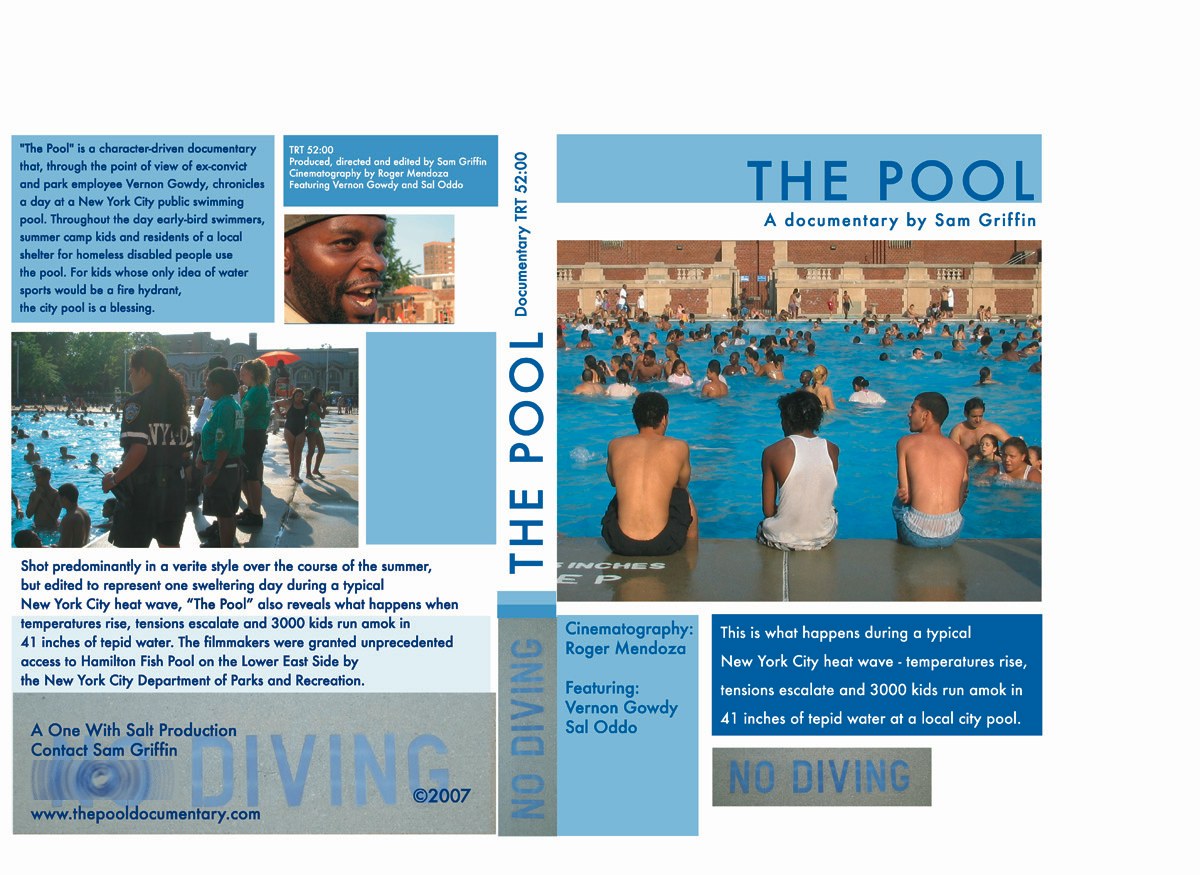
Below is an excellent example of a DVD cover for a film festival submission. It's for a documentary called The Pool by Sam Griffin (read more about Sam's film at thepooldocumentary.com). Notice how Sam and her designer Sol Armada used photos and the color scheme from the swimming pool (greys and blues) to give the reader an immediate impression of the film's tone, and also to play on the reader's own memories of swimming pools in the summer. Read the synopsis to see a great example of setting expectations -- if you've read the cover, you're probably curious to see what a pool looks like with 3000 people in it. Click the image below to see a version large enough to read.

(Thanks to Sam Griffin for allowing me to use her as an example. I've blurred out her e-mail and phone number on the cover here but I'm sure you could probably find her if you looked hard enough.)


 Chris Holland has been writing about movies since 1991. In 1996 he co-founded